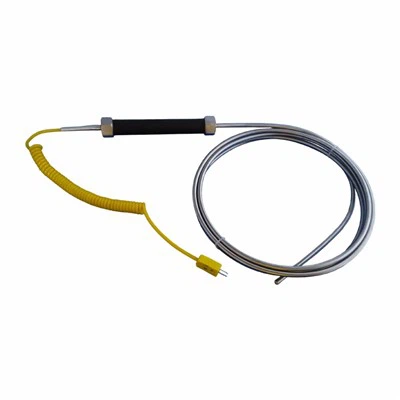
The dynamic response of a thermocouple is a crucial aspect that significantly impacts its performance in various industrial applications. As a thermocouple supplier, I've witnessed firsthand how the dynamic characteristics of these temperature sensors can make or break a project. Understanding the dynamic response of a thermocouple is essential for engineers and technicians who rely on accurate temperature measurements in real - time scenarios.
Basics of Thermocouples
Before delving into the dynamic response, let's briefly review what a thermocouple is. A thermocouple is a temperature - measuring device consisting of two dissimilar metals joined at one end. When there is a temperature difference between the junction (the measuring end) and the reference end, a voltage is generated according to the Seebeck effect. This voltage is proportional to the temperature difference, and by knowing the reference temperature and measuring the voltage, we can determine the temperature at the junction.
At the heart of a thermocouple's operation is the thermoelectric effect, where the flow of electrons due to temperature gradients in the two dissimilar metals creates an electric potential. This potential is then used to calculate temperature, but the process is not instantaneous. The time it takes for the thermocouple to accurately reflect a change in temperature is what we refer to as its dynamic response.


Factors Affecting Dynamic Response
Several factors influence the dynamic response of a thermocouple. One of the most significant factors is the mass of the thermocouple junction. A larger junction mass means more heat capacity, and it will take longer for the junction to reach thermal equilibrium with the surrounding medium. For example, a thick - wire thermocouple will generally have a slower response time compared to a thin - wire one. The Wire Thermocouple we offer comes in different wire gauges, and customers can choose the appropriate one based on their requirements for response time and durability.
The thermal conductivity of the materials used in the thermocouple also plays a vital role. Higher thermal conductivity allows heat to transfer more quickly between the junction and the surrounding environment. Metals with high thermal conductivity, such as copper or aluminum, can enhance the dynamic response of a thermocouple. However, the selection of materials is also constrained by other factors like chemical resistance and the temperature range of operation.
The heat transfer coefficient between the thermocouple and the medium it is measuring is another critical factor. A high heat transfer coefficient means that heat can be transferred more rapidly between the thermocouple and the medium. For instance, in a well - stirred liquid, the heat transfer coefficient is relatively high, resulting in a faster dynamic response compared to a stagnant gas environment.
Measuring and Characterizing Dynamic Response
To measure the dynamic response of a thermocouple, we typically use step - change tests. In a step - change test, the thermocouple is suddenly exposed to a new temperature, and the time it takes for the thermocouple output to reach a certain percentage (usually 63.2%) of the final value is recorded. This time is known as the time constant (τ). A smaller time constant indicates a faster dynamic response.
The response of a thermocouple can also be characterized using its frequency response. In applications where the temperature varies rapidly, such as in some combustion processes or high - speed manufacturing operations, the frequency response of the thermocouple becomes crucial. The frequency response of a thermocouple describes how well it can track temperature changes at different frequencies. A thermocouple with a good frequency response can accurately measure rapidly changing temperatures without significant phase lag.
Importance in Industrial Applications
In industrial applications, the dynamic response of a thermocouple can have far - reaching consequences. In processes where temperature control is critical, a slow - responding thermocouple can lead to over - or under - heating, resulting in product quality issues or even equipment damage. For example, in a chemical reactor, precise temperature control is necessary to ensure the proper chemical reactions take place. If the thermocouple used to monitor the temperature has a slow dynamic response, it may not detect sudden temperature changes in time, which could lead to dangerous reactions or substandard product quality.
In the food processing industry, accurate and fast - responding temperature measurements are essential for food safety. Thermocouples are used to monitor the cooking and cooling processes of food products. A thermocouple with a poor dynamic response may not accurately measure the temperature during the critical stages of food processing, potentially allowing harmful bacteria to survive.
Our Product Offerings and Dynamic Response
As a thermocouple supplier, we understand the importance of offering thermocouples with excellent dynamic response characteristics. Our Wire Thermocouple products are designed to provide a balance between response time and durability. By using thin - gauge wires, we are able to reduce the junction mass and improve the dynamic response.
In addition to wire thermocouples, we also offer other temperature - sensing products such as Explosion - proof RTD and Armored Resistance Temperature Detector. While these are not thermocouples, they also have their own dynamic response characteristics. The explosion - proof RTD is designed for use in hazardous environments, and its dynamic response is optimized to ensure reliable temperature measurements even in challenging conditions. The armored resistance temperature detector offers enhanced protection and a good dynamic response, making it suitable for a wide range of industrial applications.
Conclusion
The dynamic response of a thermocouple is a key parameter that affects its performance in various industrial applications. By understanding the factors that influence dynamic response, such as junction mass, thermal conductivity, and heat transfer coefficient, engineers and technicians can select the most appropriate thermocouple for their specific needs.
As a thermocouple supplier, we are committed to providing high - quality products with excellent dynamic response characteristics. Our diverse range of thermocouples and other temperature - sensing devices are designed to meet the demands of different industries. Whether you are in the chemical, food processing, or any other industry that requires accurate temperature measurements, we have the right solution for you.
If you are interested in learning more about our thermocouples and other temperature - sensing products, or if you have specific requirements for your project, we encourage you to contact us for procurement and further discussions. We look forward to working with you to find the best temperature - measurement solutions for your needs.
References
- "Fundamentals of Thermocouple Technology" by the International Society of Automation.
- "Temperature Measurement" by John M. Masters, which provides in - depth knowledge on the dynamic characteristics of temperature sensors.