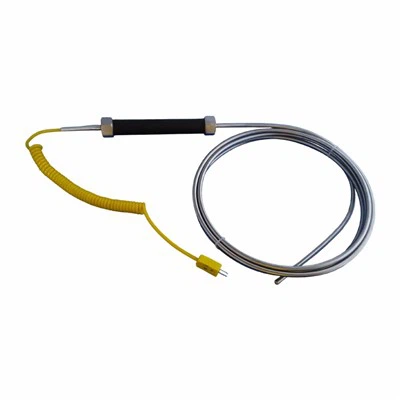
Hey there! As a supplier of magnetic thermocouples, I often get asked about the output signal of these nifty devices. So, let's dive right in and explore what the output signal of a magnetic thermocouple is all about.
First off, let's understand what a magnetic thermocouple is. It's a type of temperature sensor that uses the principle of the Seebeck effect. The Seebeck effect is the phenomenon where a voltage is generated when two different metals are joined at two junctions and there's a temperature difference between these junctions.
The output signal of a magnetic thermocouple is an electrical voltage. This voltage is directly proportional to the temperature difference between the measuring junction (the one exposed to the temperature we want to measure) and the reference junction (usually kept at a known, constant temperature).
Now, the magnitude of this output voltage is pretty small. It's typically in the range of millivolts. For example, for a common type - K thermocouple, the output voltage might change by about 41 microvolts per degree Celsius change in temperature.
The reason the output is a voltage is that the thermocouple acts like a little battery. When there's a temperature difference, the electrons in the two different metals start to move. This movement of electrons creates an electric current, and the voltage is a measure of the potential difference that drives this current.
The output signal of a magnetic thermocouple is also affected by the type of metals used in the thermocouple. Different metal combinations have different Seebeck coefficients, which determine how much voltage is generated per degree of temperature change. For instance, type - J thermocouples, which are made of iron and constantan, have a different output voltage characteristic compared to type - T thermocouples, which are made of copper and constantan.
One of the great things about magnetic thermocouples is their wide temperature range. They can measure temperatures from extremely low, like -200°C, all the way up to over 1000°C, depending on the type. This wide range makes them suitable for a variety of applications, from industrial processes to scientific research.
In industrial settings, magnetic thermocouples are used for monitoring and controlling temperature in things like furnaces, ovens, and chemical reactors. The output signal is sent to a control system, which can then adjust the heating or cooling to maintain the desired temperature.
Now, let's talk about the practical aspects of dealing with the output signal. Since the output voltage is so small, it often needs to be amplified. This is usually done using an amplifier circuit. The amplified signal can then be processed by a data acquisition system or a temperature controller.
Another important consideration is the accuracy of the output signal. There are several factors that can affect the accuracy of a magnetic thermocouple, such as the quality of the metals, the calibration of the thermocouple, and the environmental conditions. For example, if there's a lot of electromagnetic interference in the area, it can cause noise in the output signal, which can lead to inaccurate temperature readings.
To ensure accurate readings, it's important to use high - quality thermocouples and to calibrate them regularly. Calibration involves comparing the output of the thermocouple with a known temperature source.
We also offer different types of thermocouples to meet various needs. For example, we have Armored Thermocouple. These are great for applications where the thermocouple needs to be protected from mechanical damage. The armored design also helps to reduce the effects of electromagnetic interference.
Our Explosion - proof Thermocouple is perfect for hazardous environments where there's a risk of explosion. These thermocouples are designed to prevent any sparks or heat from the thermocouple from igniting the surrounding atmosphere.


And then there's the Wire Thermocouple. These are more flexible and are often used in applications where the thermocouple needs to be bent or moved around.
If you're in the market for magnetic thermocouples or any of the other types we offer, we'd love to have a chat with you. Whether you're working on a small research project or a large - scale industrial operation, we can help you find the right thermocouple for your needs. Just reach out to us, and we'll be happy to discuss your requirements and provide you with a quote.
In conclusion, the output signal of a magnetic thermocouple is a small electrical voltage that's proportional to the temperature difference between the measuring and reference junctions. It's a crucial part of many temperature - monitoring and control systems, and understanding it is key to getting accurate temperature readings.
References:
- "Thermocouples: Theory and Practice" by John Wiley & Sons
- "Temperature Measurement Handbook" by Omega Engineering