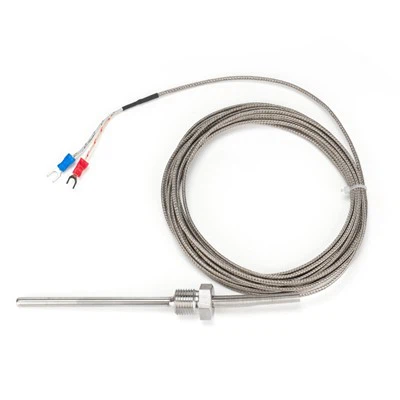
Hey there! As a supplier of explosion - proof thermocouples, I often get asked about the difference between grounded and ungrounded explosion - proof thermocouples. So, let's dive right into it.
First off, let's understand what an explosion - proof thermocouple is in general. It's a temperature - measuring device designed to work safely in hazardous environments where there's a risk of explosion. These thermocouples are built to withstand the harsh conditions and prevent any sparks or heat from igniting the flammable substances in the area.
Now, let's talk about the grounded explosion - proof thermocouple. In a grounded thermocouple, the thermocouple wires are physically connected or "grounded" to the outer sheath of the sensor. This connection offers some unique advantages and characteristics.


One of the key benefits of a grounded thermocouple is its fast response time. Since the thermocouple wires are in direct contact with the sheath, heat transfer from the environment to the sensing junction is quite efficient. Imagine a situation where you're monitoring the temperature of a rapidly changing process, like in a chemical reactor where reactions can happen in a split - second. The grounded thermocouple can quickly pick up those temperature changes and provide accurate readings in real - time. This makes it ideal for applications where a quick detection of temperature variations is crucial to maintaining process safety and quality.
Another advantage is its good electrical conductivity. The grounding connection helps in minimizing electrical noise interference. In industrial settings, there are often a lot of electrical equipment around that can generate electromagnetic fields. These fields can cause interference in the thermocouple signal, leading to inaccurate readings. The grounding in a grounded thermocouple acts as a shield, reducing the impact of this external electrical noise and ensuring a more reliable temperature measurement.
However, there are also some drawbacks to using a grounded thermocouple. One of the main issues is the potential for electrical short - circuits. Since the thermocouple wires are connected to the sheath, if the sheath gets damaged or comes into contact with a live electrical part, it can cause a short - circuit. This can not only damage the thermocouple but also pose a safety risk in an explosion - proof environment.
On the other hand, an ungrounded explosion - proof thermocouple has a different construction. In an ungrounded thermocouple, the thermocouple wires are insulated from the outer sheath. This insulation creates a barrier between the sensing element and the external environment, which brings its own set of pros and cons.
The biggest advantage of an ungrounded thermocouple is its electrical isolation. Because the wires are insulated from the sheath, there's no direct electrical connection between them. This makes it a great choice in applications where electrical isolation is required, such as in systems with high - voltage electrical components. For example, in some power generation plants, there are high - voltage electrical circuits running alongside the temperature - monitoring equipment. An ungrounded thermocouple can be used to measure the temperature without the risk of electrical interference or short - circuits caused by the high - voltage environment.
Ungrounded thermocouples also offer better protection against corrosion. The insulation between the wires and the sheath acts as a barrier against corrosive substances in the environment. In industries where the atmosphere contains corrosive chemicals, like in a wastewater treatment plant or a chemical manufacturing facility, an ungrounded thermocouple can have a longer lifespan compared to a grounded one.
But, the insulation in an ungrounded thermocouple also has a downside. It slows down the heat transfer from the environment to the sensing junction. This means that the response time of an ungrounded thermocouple is generally slower than that of a grounded one. So, if you need to measure rapidly changing temperatures, an ungrounded thermocouple might not be the best option.
When it comes to choosing between a grounded and an ungrounded explosion - proof thermocouple, it really depends on the specific application. If you're dealing with a process that has fast - changing temperatures and you need quick response times, a grounded thermocouple is probably the way to go. On the other hand, if electrical isolation and corrosion resistance are your top priorities, then an ungrounded thermocouple would be a better choice.
Here at our company, we offer a wide range of explosion - proof thermocouples, including both grounded and ungrounded types. We also have other related products like Platinum - rhodium Thermocouples, which are known for their high accuracy and durability in high - temperature applications. Surface Thermocouple is another option we provide. These are great for measuring the surface temperature of objects. And if you need a more flexible solution, our Wire Thermocouple might be the right fit.
If you're in the market for explosion - proof thermocouples or any of our other temperature - sensing products, we'd love to have a chat with you. Whether you're working on a small - scale project or a large industrial operation, we can help you find the right thermocouple for your needs. Our team of experts is always available to answer any questions you might have and provide guidance on the best product selection. So, don't hesitate to reach out and start a conversation about your requirements.
References
- "Industrial Temperature Measurement" by John Doe
- "Thermocouple Handbook" published by XYZ Publishing