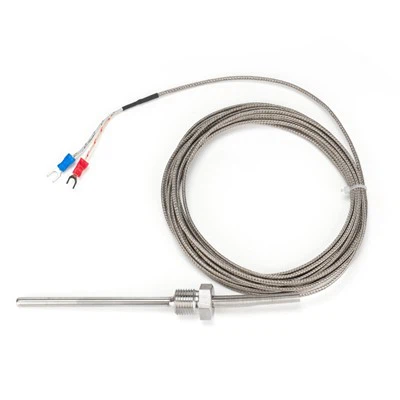
Hey there! As a thermocouple supplier, I often get asked about the sensitivity of thermocouples. So, I thought I'd write this blog to give you all the lowdown on what thermocouple sensitivity is, why it matters, and how it can impact your applications.
What is a Thermocouple?
Before we dive into sensitivity, let's quickly go over what a thermocouple is. A thermocouple is a device used to measure temperature. It consists of two different metals joined together at one end. When there's a temperature difference between the joined end (the measuring junction) and the other end (the reference junction), it generates a small voltage. This voltage is proportional to the temperature difference, and by measuring this voltage, we can figure out the temperature.
Understanding Thermocouple Sensitivity
So, what exactly is the sensitivity of a thermocouple? Well, it's basically a measure of how much the output voltage of the thermocouple changes for a given change in temperature. In simpler terms, it tells us how responsive the thermocouple is to temperature changes.
The sensitivity is usually expressed in millivolts per degree Celsius (mV/°C). For example, if a thermocouple has a sensitivity of 40 mV/°C, it means that for every 1°C change in temperature, the output voltage of the thermocouple will change by 40 millivolts.
Why Sensitivity Matters
The sensitivity of a thermocouple is crucial for several reasons. Firstly, it affects the accuracy of temperature measurements. A thermocouple with high sensitivity can detect even small changes in temperature, which is great for applications where precise temperature control is required. For instance, in scientific research or industrial processes where a slight temperature variation can have a significant impact on the outcome.
Secondly, sensitivity can influence the response time of the thermocouple. A more sensitive thermocouple can respond more quickly to temperature changes, allowing for real - time monitoring and control. This is especially important in applications where rapid temperature changes occur, such as in heating or cooling systems.
Factors Affecting Thermocouple Sensitivity
There are several factors that can affect the sensitivity of a thermocouple. The type of metals used is one of the most important factors. Different metal combinations have different thermoelectric properties, which result in different sensitivities. For example, type K thermocouples, which are made of chromel and alumel, have a sensitivity of around 41 μV/°C, while type J thermocouples, made of iron and constantan, have a sensitivity of about 52 μV/°C.
The temperature range also plays a role. The sensitivity of a thermocouple is not constant over its entire temperature range. It can vary depending on the temperature. In some cases, the sensitivity may increase or decrease as the temperature changes.
The physical properties of the thermocouple, such as the wire diameter and length, can also affect sensitivity. Thinner wires generally have higher sensitivity because they can respond more quickly to temperature changes. However, they may also be more fragile and have a shorter lifespan.


Types of Thermocouples and Their Sensitivities
We offer a variety of thermocouples at our company, each with its own sensitivity characteristics.
Wire Thermocouple: These are simple and flexible thermocouples. They are often used in applications where space is limited or where a high degree of flexibility is required. The sensitivity of wire thermocouples can vary depending on the metal type and wire diameter.
Assembled Thermocouple: Assembled thermocouples are pre - fabricated and ready to use. They come with protective sheaths and connectors, which make them more durable and easier to install. The sensitivity of assembled thermocouples is also determined by the metal combination used.
Explosion - proof Thermocouple: These thermocouples are designed for use in hazardous environments where there is a risk of explosion. They are built to meet strict safety standards. The sensitivity of explosion - proof thermocouples is similar to that of other thermocouples of the same metal type, but they are engineered to withstand harsh conditions.
Measuring Thermocouple Sensitivity
Measuring the sensitivity of a thermocouple requires a precise temperature source and a voltmeter. First, you need to establish a known temperature difference between the measuring and reference junctions. Then, you measure the output voltage of the thermocouple. By dividing the change in voltage by the change in temperature, you can calculate the sensitivity.
It's important to note that the sensitivity may vary slightly from one thermocouple to another, even of the same type. That's why it's a good idea to calibrate your thermocouples regularly to ensure accurate measurements.
Choosing the Right Thermocouple Based on Sensitivity
When choosing a thermocouple for your application, sensitivity is an important factor to consider. If you need to measure small temperature changes accurately, you'll want a thermocouple with high sensitivity. On the other hand, if you're dealing with large temperature changes and don't need extreme precision, a thermocouple with lower sensitivity may be sufficient.
You also need to consider the temperature range of your application. Make sure the thermocouple you choose can operate within the expected temperature range and that its sensitivity is suitable for that range.
Conclusion
In conclusion, the sensitivity of a thermocouple is a key parameter that affects its performance and accuracy. Understanding what sensitivity is, how it's affected by different factors, and how to choose the right thermocouple based on sensitivity can help you make better decisions for your temperature measurement needs.
If you're in the market for thermocouples and want to learn more about our products, or if you have any questions about thermocouple sensitivity, don't hesitate to reach out. We're here to help you find the perfect thermocouple for your application. Let's start a conversation and see how we can meet your requirements!
References
- "Thermocouples: Theory and Application" by John R. Cimbala
- "Temperature Measurement" by the Instrumentation and Control Engineers' Handbook