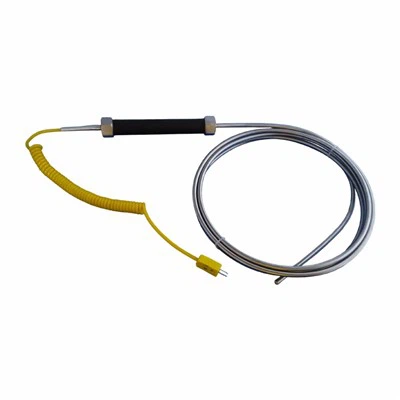
When it comes to temperature measurement in industrial and scientific applications, two of the most commonly used sensors are thermocouples and Resistance Temperature Detectors (RTDs). As a thermocouple supplier, I often encounter customers who are confused about the differences between these two types of temperature sensors. In this blog post, I will delve into the characteristics, advantages, and disadvantages of thermocouples and RTDs to help you make an informed decision when choosing the right temperature sensor for your specific needs.
Working Principles
Thermocouples
Thermocouples are based on the Seebeck effect, which was discovered by Thomas Johann Seebeck in 1821. The Seebeck effect states that when two different metals are joined at two junctions and there is a temperature difference between the two junctions, an electromotive force (EMF) is generated. This EMF is proportional to the temperature difference between the two junctions.
A thermocouple consists of two dissimilar metal wires joined at one end, known as the measuring junction. The other ends of the wires are connected to a measuring instrument, such as a thermometer or a data logger. The measuring junction is exposed to the temperature being measured, while the other end, known as the reference junction, is maintained at a known temperature. The EMF generated by the thermocouple is then measured, and the temperature at the measuring junction can be determined based on the known relationship between the EMF and temperature.
There are several types of thermocouples, each with different combinations of metals and temperature ranges. Some common types include Type K (chromel - alumel), Type J (iron - constantan), and Type T (copper - constantan).
RTDs
Resistance Temperature Detectors (RTDs) operate on the principle that the electrical resistance of a metal changes with temperature. Most RTDs are made of pure metals, such as platinum, nickel, or copper, because these metals have a well - defined and predictable relationship between resistance and temperature.
The resistance of an RTD increases as the temperature rises. The relationship between resistance and temperature is typically described by a polynomial equation. For example, for a platinum RTD, the resistance - temperature relationship is often characterized by the Callendar - Van Dusen equation.
RTDs are usually constructed by winding a fine wire of the metal around a ceramic or glass bobbin. The wire is then enclosed in a protective sheath to prevent damage and contamination.
Temperature Range
Thermocouples
One of the key advantages of thermocouples is their wide temperature range. Different types of thermocouples can measure temperatures from as low as - 270°C to as high as 2300°C. For example, Type K thermocouples can measure temperatures from - 200°C to 1372°C, while Type B thermocouples can measure temperatures from 0°C to 1820°C. This wide temperature range makes thermocouples suitable for a variety of high - temperature applications, such as in furnaces, kilns, and metal processing.
RTDs
RTDs generally have a more limited temperature range compared to thermocouples. Platinum RTDs, which are the most commonly used type, can typically measure temperatures from - 200°C to 850°C. While this range is sufficient for many industrial applications, it may not be suitable for extremely high - temperature environments.
Accuracy
Thermocouples
Thermocouples are known for their relatively lower accuracy compared to RTDs. The accuracy of a thermocouple can be affected by several factors, including the type of thermocouple, the quality of the materials, and the measurement environment. The accuracy of a typical thermocouple can range from ±0.5°C to ±5°C, depending on the type and application. However, in some high - precision applications, special thermocouples with higher accuracy can be used.
RTDs
RTDs are generally more accurate than thermocouples. Platinum RTDs, in particular, can provide very high accuracy, with an accuracy of ±0.1°C to ±0.5°C being common. This high accuracy makes RTDs suitable for applications where precise temperature measurement is required, such as in laboratories, pharmaceutical manufacturing, and food processing.
Response Time
Thermocouples
Thermocouples have a relatively fast response time compared to RTDs. Since thermocouples are based on the generation of an EMF due to a temperature difference, they can quickly detect changes in temperature. The response time of a thermocouple can be as fast as a few milliseconds, depending on the size and construction of the thermocouple. This fast response time makes thermocouples suitable for applications where rapid temperature changes need to be monitored, such as in combustion processes and dynamic testing.
RTDs
RTDs have a slower response time compared to thermocouples. The response time of an RTD is mainly determined by the thermal mass of the sensor and the heat transfer characteristics of the surrounding environment. It can take several seconds to reach a stable reading, especially in applications where the temperature changes rapidly. However, for applications where the temperature changes slowly, the response time of an RTD may not be a significant issue.
Cost
Thermocouples
Thermocouples are generally less expensive than RTDs. The materials used in thermocouples, such as chromel, alumel, and constantan, are relatively inexpensive, and the manufacturing process is also relatively simple. This makes thermocouples a cost - effective option for applications where high accuracy is not required and a wide temperature range is needed.
RTDs
RTDs are more expensive than thermocouples, mainly due to the use of high - purity metals, such as platinum, and the complex manufacturing process. The cost of an RTD can be several times higher than that of a thermocouple, especially for high - accuracy and high - temperature RTDs. However, the higher cost may be justified in applications where high accuracy and long - term stability are critical.
Applications
Thermocouples
Thermocouples are widely used in a variety of industrial applications, especially those involving high temperatures. Some common applications include:
- Industrial furnaces and kilns: Thermocouples are used to monitor and control the temperature in furnaces and kilns for processes such as metal melting, heat treatment, and ceramic firing.
- Power generation: Thermocouples are used to measure the temperature of steam, gas, and other fluids in power plants, including boilers, turbines, and condensers.
- Automotive industry: Thermocouples are used to measure the temperature of the engine, exhaust system, and other components in vehicles.
You can find a variety of thermocouples for different applications on our website, including Armored Thermocouple, Explosion - proof Thermocouple, and Surface Thermocouple.
RTDs
RTDs are commonly used in applications where high accuracy and stability are required. Some common applications include:
- Laboratory equipment: RTDs are used in laboratory instruments such as incubators, ovens, and refrigerators to ensure precise temperature control.
- Pharmaceutical manufacturing: RTDs are used to monitor and control the temperature during the production of drugs and pharmaceutical products to ensure product quality and safety.
- Food processing: RTDs are used to measure the temperature of food during processing, storage, and transportation to ensure food safety and quality.
Conclusion
In summary, thermocouples and RTDs have different characteristics, advantages, and disadvantages. Thermocouples are suitable for applications that require a wide temperature range, fast response time, and low cost. RTDs, on the other hand, are more suitable for applications that require high accuracy, stability, and relatively lower temperature ranges.


As a thermocouple supplier, we offer a wide range of thermocouples to meet the diverse needs of our customers. Whether you need a thermocouple for high - temperature industrial applications or a precise temperature sensor for laboratory use, we have the right solution for you. If you have any questions or need assistance in choosing the right temperature sensor for your application, please contact us for more information. We are ready to help you make the best decision for your temperature measurement needs.
References
- "Temperature Measurement Handbook", Omega Engineering
- "Thermocouples: Theory and Practice", J. F. Schooley
- "Resistance Temperature Detectors (RTDs): Principles and Applications", Temperature Sensors World