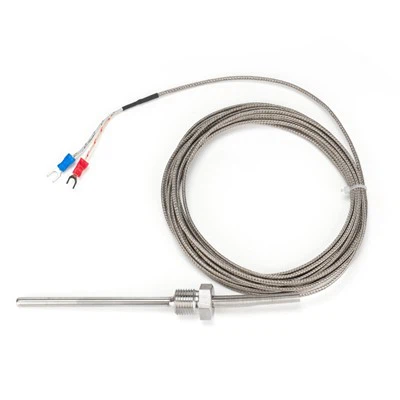
Hey there! As a supplier of resistance temperature detectors (RTDs), I often get asked about the insulation resistance requirements for these nifty devices. So, I thought I'd take a few minutes to break it down for you.
First off, let's talk about what insulation resistance is. In simple terms, it's a measure of how well the electrical insulation in an RTD can resist the flow of electric current. This is super important because if the insulation resistance is too low, it can lead to all sorts of problems, like inaccurate temperature readings or even electrical shorts.
The insulation resistance requirement for an RTD can vary depending on a few different factors. One of the biggest factors is the application. For example, if you're using an RTD in a high - voltage or high - humidity environment, you'll need a higher insulation resistance to ensure reliable operation.
In general, for most industrial applications, an insulation resistance of at least 100 megohms (MΩ) at room temperature is a good starting point. This level of insulation resistance helps to prevent leakage currents that could interfere with the RTD's ability to accurately measure temperature.
When it comes to our products, we offer a range of RTDs with different insulation resistance capabilities. For instance, our Prefabricated RTD is designed for easy installation and comes with high - quality insulation to meet or exceed the standard insulation resistance requirements. It's a great choice for applications where you need a reliable and pre - assembled RTD.
Our Wire Resistance Thermometer is another option. This type of RTD is often used in more customized applications. We make sure that the wire insulation has a high enough resistance to ensure accurate temperature measurements, even in challenging environments.
If you're working in an environment where there's a risk of explosion, our Explosion - proof RTD is the way to go. These RTDs are specially designed with extra - thick insulation and other safety features to prevent electrical sparks that could ignite flammable gases or dust. The insulation resistance requirements for explosion - proof RTDs are typically even higher than for standard RTDs to ensure maximum safety.
Now, let's talk about how to test the insulation resistance of an RTD. You can use a megohmmeter, which is a device specifically designed to measure high resistances. To test the insulation resistance, you'll need to connect the megohmmeter to the RTD's conductors and the outer sheath or housing. Make sure the RTD is disconnected from any power sources before you start the test.
Here are the general steps for testing insulation resistance:
- Set the megohmmeter to the appropriate range. For most RTDs, a range of 100 MΩ or higher is suitable.
- Connect the megohmmeter leads to the RTD. One lead should be connected to the RTD's conductors, and the other lead should be connected to the outer sheath or housing.
- Take the measurement. The megohmmeter will display the insulation resistance value. Make sure the value meets the required specifications for your application.
It's also important to note that insulation resistance can change over time due to factors like temperature, humidity, and mechanical stress. So, it's a good idea to regularly test the insulation resistance of your RTDs to ensure they're still performing properly.


If you're in the market for RTDs and have questions about insulation resistance or any other aspect of our products, don't hesitate to reach out. We're here to help you find the right RTD for your specific needs. Whether you're working on a small - scale project or a large - scale industrial application, we've got the expertise and the products to meet your requirements.
In conclusion, understanding the insulation resistance requirements for RTDs is crucial for ensuring accurate temperature measurements and reliable operation. Our range of RTDs, including the Prefabricated RTD, Wire Resistance Thermometer, and Explosion - proof RTD, are designed to meet a variety of insulation resistance needs. If you're interested in purchasing RTDs or need more information, feel free to contact us. We're looking forward to working with you!
References:
- Electrical Engineering Handbook: Temperature Measurement and Sensors
- Industry standards for resistance temperature detectors