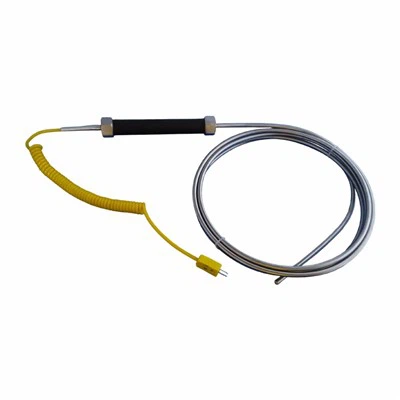
Resistance temperature detectors (RTDs) are crucial instruments in temperature measurement across various industries, from manufacturing to scientific research. They operate on the principle that the electrical resistance of a metal changes predictably with temperature. As a leading supplier of RTDs, we understand the importance of adhering to international standards to ensure the accuracy, reliability, and safety of our products. In this blog, we will explore the key international standards for RTDs and how they impact our offerings.
I. The Basics of Resistance Temperature Detectors
Before delving into the standards, it's essential to understand the fundamental principles of RTDs. RTDs typically use pure metals such as platinum, nickel, or copper as the sensing element. Platinum is the most commonly used material due to its high accuracy, stability, and wide temperature range. The resistance of the sensing element changes linearly with temperature, allowing for precise temperature measurement.
Our company offers a wide range of RTD products, including Prefabricated RTD, Armored Resistance Temperature Detector, and Explosion-proof RTD. These products are designed to meet the diverse needs of our customers in different applications.


II. International Standards for RTDs
A. IEC 60751
The International Electrotechnical Commission (IEC) standard 60751 is the most widely recognized standard for industrial platinum resistance thermometers (PRTs). This standard defines the characteristics of PRTs, including the temperature coefficient of resistance (TCR), the nominal resistance at 0°C (R₀), and the tolerance classes.
-
Temperature Coefficient of Resistance (TCR)
The TCR is a measure of how the resistance of the RTD changes with temperature. For platinum RTDs, the standard TCR is defined as 0.00385 Ω/Ω/°C, also known as the European Curve. This value represents the change in resistance per degree Celsius relative to the resistance at 0°C. Our RTDs are designed to meet this standard TCR, ensuring accurate temperature measurement. -
Nominal Resistance at 0°C (R₀)
The nominal resistance at 0°C is another important parameter defined by IEC 60751. Common values for R₀ include 100 Ω and 1000 Ω. The choice of R₀ depends on the specific application and the requirements of the measurement system. Our RTDs are available in both 100 Ω and 1000 Ω configurations to meet the needs of different customers. -
Tolerance Classes
IEC 60751 defines several tolerance classes for PRTs, including Class A, Class B, and Special Class. These classes specify the maximum allowable deviation of the RTD's resistance from the ideal curve at various temperatures. Class A has the highest accuracy, with a tolerance of ±(0.15 + 0.002|t|) °C, where t is the temperature in degrees Celsius. Our RTDs are available in different tolerance classes to provide customers with options based on their accuracy requirements.
B. ASTM E1137
The American Society for Testing and Materials (ASTM) standard E1137 is similar to IEC 60751 and is widely used in North America. This standard also defines the characteristics of platinum RTDs, including the TCR, R₀, and tolerance classes. The main difference between ASTM E1137 and IEC 60751 is the TCR value. ASTM E1137 uses a TCR of 0.003926 Ω/Ω/°C, known as the American Curve.
Our company is committed to meeting both IEC 60751 and ASTM E1137 standards to ensure that our RTDs are suitable for customers in different regions. We can provide RTDs with either the European Curve or the American Curve, depending on the customer's requirements.
C. Other Standards
In addition to IEC 60751 and ASTM E1137, there are other standards that may apply to RTDs in specific industries or applications. For example, the National Institute of Standards and Technology (NIST) in the United States provides calibration services and reference standards for temperature measurement. Our RTDs can be calibrated to NIST standards to ensure traceability and accuracy.
III. Importance of Adhering to International Standards
Adhering to international standards is essential for several reasons. First, it ensures the accuracy and reliability of temperature measurement. By using RTDs that meet the standards, customers can have confidence in the temperature readings and make informed decisions based on the data.
Second, international standards promote interoperability and compatibility. When RTDs from different manufacturers meet the same standards, they can be used interchangeably in measurement systems, reducing the need for custom calibration and integration.
Third, compliance with standards is often a requirement for regulatory approval in certain industries. For example, in the pharmaceutical and food industries, temperature measurement must meet strict regulatory requirements to ensure product quality and safety. Our RTDs are designed to meet these regulatory requirements, providing customers with peace of mind.
IV. Our Commitment to Quality and Compliance
As a supplier of RTDs, we are committed to providing high-quality products that meet or exceed international standards. We have a rigorous quality control system in place to ensure that every RTD we produce meets the specified requirements. Our manufacturing processes are designed to minimize variability and ensure consistent performance.
We also offer calibration services to ensure that our RTDs are accurate and traceable. Our calibration laboratory is equipped with state-of-the-art equipment and staffed by experienced technicians. We can calibrate our RTDs to IEC 60751, ASTM E1137, or other relevant standards, depending on the customer's needs.
V. Contact Us for RTD Procurement
If you are in the market for high-quality RTDs that meet international standards, we invite you to contact us for procurement discussions. Our team of experts can help you select the right RTD for your application and provide you with detailed technical information and support. Whether you need a Prefabricated RTD, Armored Resistance Temperature Detector, or Explosion-proof RTD, we have the products and expertise to meet your needs.
References
- International Electrotechnical Commission. (2018). IEC 60751: Industrial platinum resistance thermometers and platinum temperature sensors.
- American Society for Testing and Materials. (2017). ASTM E1137: Standard specification and test methods for industrial platinum resistance thermometers.
- National Institute of Standards and Technology. (n.d.). Temperature measurement standards.