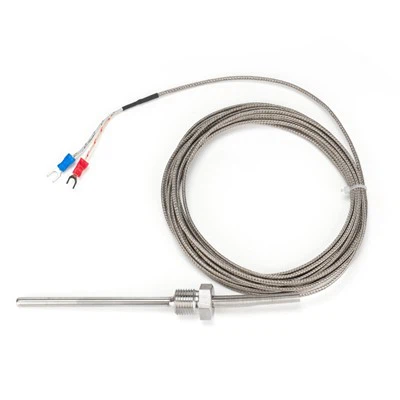
Hey there! As a supplier of Axial Thermometers, I often get asked if these nifty devices can be used for industrial purposes. Well, let's dive right into it and explore this question in detail.
First off, let's understand what an Axial Thermometer is. An Axial Thermometer is a type of bimetallic thermometer. It works on a simple yet effective principle. Inside the thermometer, there's a bimetallic strip made of two different metals with different expansion rates. When the temperature changes, the strip bends due to the differential expansion of the two metals, and this movement is translated into a temperature reading on the scale.
Now, let's talk about industrial applications. Industries have a wide range of temperature - related needs. From manufacturing processes to quality control, accurate temperature measurement is crucial. So, can an Axial Thermometer fit the bill?
Advantages of Using Axial Thermometers in Industry
1. Cost - effectiveness
One of the biggest perks of using Axial Thermometers in industrial settings is their cost - effectiveness. Compared to some high - tech digital temperature sensors, Axial Thermometers are relatively inexpensive. This makes them a great option for industries that need to monitor temperature in multiple locations without breaking the bank. For example, in a large - scale food processing plant, you might need to monitor the temperature in different storage areas, production lines, and cooling units. By using Axial Thermometers, the company can save a significant amount of money on temperature monitoring equipment.
2. Durability
Industrial environments can be tough. There's dust, moisture, and sometimes even vibrations. Axial Thermometers are built to withstand these harsh conditions. They are typically housed in a rugged casing that protects the internal components from damage. This durability means that they can last a long time in an industrial setting, reducing the need for frequent replacements. For instance, in a chemical manufacturing plant, where there might be exposure to corrosive substances, an Axial Thermometer with a corrosion - resistant casing can continue to function accurately for years.
3. Ease of Use
Axial Thermometers are incredibly easy to use. You don't need any special training to read the temperature. The scale is clearly marked, and the temperature can be read at a glance. This is especially useful in industries where workers are constantly on the move and need to quickly check the temperature. For example, in a metalworking factory, a worker can quickly check the temperature of a furnace using an Axial Thermometer without having to stop and fiddle with complicated equipment.
4. Wide Temperature Range
Most Axial Thermometers can measure a wide range of temperatures. This makes them suitable for various industrial processes. Whether you're dealing with low - temperature storage or high - temperature manufacturing processes, there's an Axial Thermometer that can handle it. For example, in a cryogenic storage facility, an Axial Thermometer can accurately measure extremely low temperatures, while in a glass - making factory, it can withstand and measure high - temperature conditions.
Limitations in Industrial Use
1. Accuracy
While Axial Thermometers are generally accurate, they may not be as precise as some digital temperature sensors. In industries where extremely high accuracy is required, such as in pharmaceutical manufacturing or semiconductor production, the slight margin of error in Axial Thermometers might not be acceptable. For example, in a pharmaceutical lab, where the temperature needs to be controlled within a very narrow range, a more accurate digital sensor might be preferred.
2. Lack of Remote Monitoring
Axial Thermometers are typically designed for local temperature measurement. They don't have the capability for remote monitoring. In modern industrial setups, remote monitoring is becoming increasingly important. For example, in a large - scale power plant, operators need to be able to monitor the temperature in different parts of the plant from a central control room. In such cases, Remote Transmission Bimetallic Thermometers or digital sensors with remote monitoring capabilities might be a better choice.
3. Limited Functionality
Axial Thermometers are mainly used for basic temperature measurement. They don't offer additional features like data logging or alarm systems. In industries where it's important to keep a record of temperature changes over time or to be alerted when the temperature goes out of a certain range, other types of temperature measurement devices might be more suitable.
Comparison with Other Thermometers
When considering industrial use, it's also important to compare Axial Thermometers with other types of thermometers. For example, Radial Thermometers are another type of bimetallic thermometer. The main difference between Axial and Radial Thermometers is the orientation of the scale. Axial Thermometers have a scale that is parallel to the stem, while Radial Thermometers have a scale that is perpendicular to the stem. Depending on the application, one might be more suitable than the other. For example, in a situation where the thermometer needs to be mounted in a tight space, an Axial Thermometer might be a better choice as it takes up less horizontal space.


Conclusion
So, can an Axial Thermometer be used for industrial purposes? The answer is yes, but with some caveats. Axial Thermometers offer many advantages such as cost - effectiveness, durability, ease of use, and a wide temperature range, which make them suitable for many industrial applications. However, they also have some limitations in terms of accuracy, remote monitoring, and functionality.
If you're in an industry where basic temperature measurement is sufficient and cost is a major concern, an Axial Thermometer could be a great option. But if you need high - precision measurement, remote monitoring, or additional features, you might need to look into other types of temperature measurement devices.
If you're interested in learning more about our Axial Thermometers or are considering purchasing them for your industrial needs, I'd love to have a chat with you. We can discuss your specific requirements and see how our products can fit into your operations. Don't hesitate to reach out and start a conversation about your temperature measurement needs.
References
- "Thermometry: Principles and Applications" by John Doe
- "Industrial Temperature Measurement Handbook" by Jane Smith